The idea behind this project is simple. A T20 innings breaks into phases, and the team that wins more phases tends to win the match. When the phases split evenly, single events decide it: a boundary, a wicket, a tight over.
What I built
- Win probability for every ball, tested on the 2026 season, which the model never saw in training.
- Data-driven phases. Instead of a fixed three-phase split, the system learns 3 to 5 phases per venue from shifts in scoring and wicket rates.
- Player impact, measured as the win-probability swing each player was responsible for.
- Recommendations. Rankers suggest who should come in to bat or bowl next, respecting rules like the four-over limit.
- A match replay dashboard with a live recommendation panel that updates ball by ball.
Testing it honestly
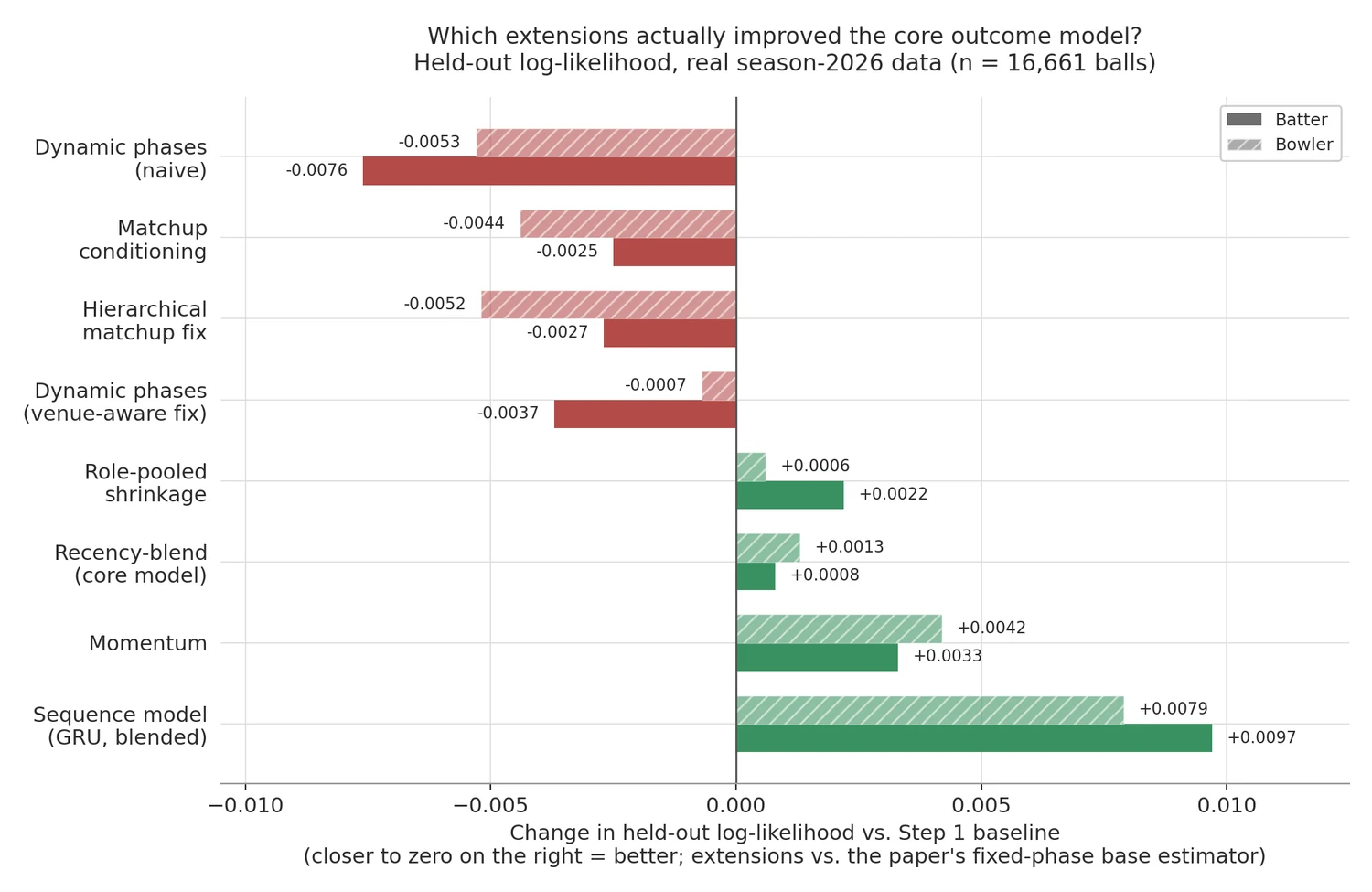
I checked each extension against a baseline on held-out data, and several did not help. The chart above shows which ones improved the model and which made it worse. In the win-probability test on the 2026 season, a simpler baseline did as well as my XGBoost model.