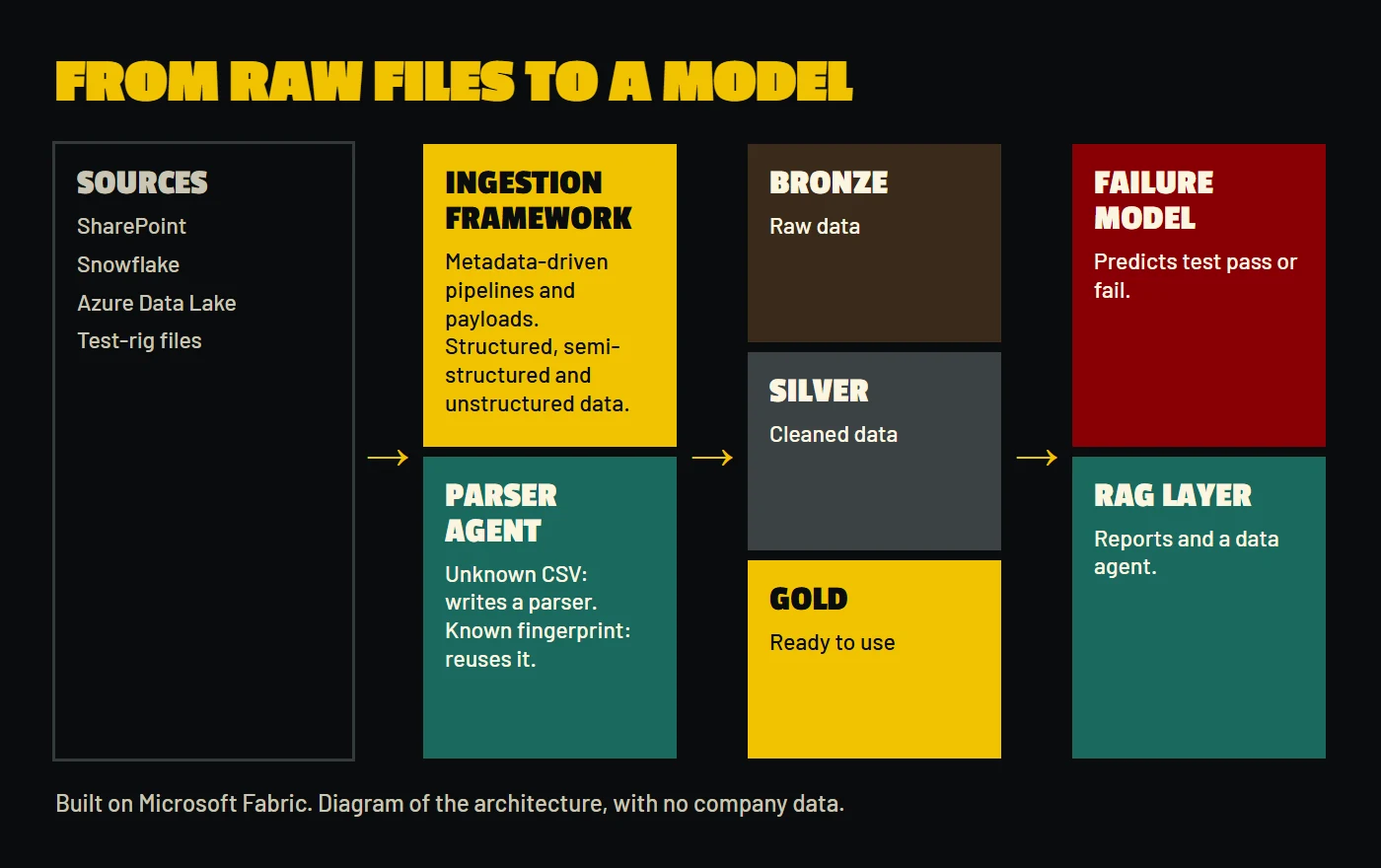
At SKF Vertevo in Gothenburg, I worked from raw data all the way to a working model. Each part feeds the next.
A unified ingestion framework
I built a framework on Microsoft Fabric that works through pipelines and payloads. It is dynamic: you describe the data you want to ingest as metadata, and the framework brings it in. It handles structured, semi-structured and unstructured data from different sources, including SharePoint, Snowflake and Azure Data Lake Storage.
A medallion architecture
On top of that, I built a medallion architecture with Spark and Delta tables. It transforms the data through increasing levels of quality, so that users and tasks further along can rely on it.
An AI agent that writes parsers
Test rigs write files in formats that vary by machine and site, including Mandarin-language output. I built an agent on Azure AI Foundry that can parse any unstructured CSV file by writing its own parser. A fingerprinting step recognises the file type, so when the same type appears again, it reuses that parser. The agent only runs on new formats or failed parses.
A model that finds test failures
Endurance tests run machines for a long time until they pass or fail. I analysed the multi-channel sensor data per time window and per channel, and found that shaft speed and power carried a stronger failure signal than bearing temperature.
There were only a few labelled runs, so I built a diffusion-based time-series encoder for anomaly detection, with a small classifier on top, to predict pass or fail.
A RAG layer
I also designed a semantic model and a RAG system over the cleaned data, which puts image and text data in one vector space. Reports and a conversational data agent use it.